

Introduction: The Data Stack Dilemma
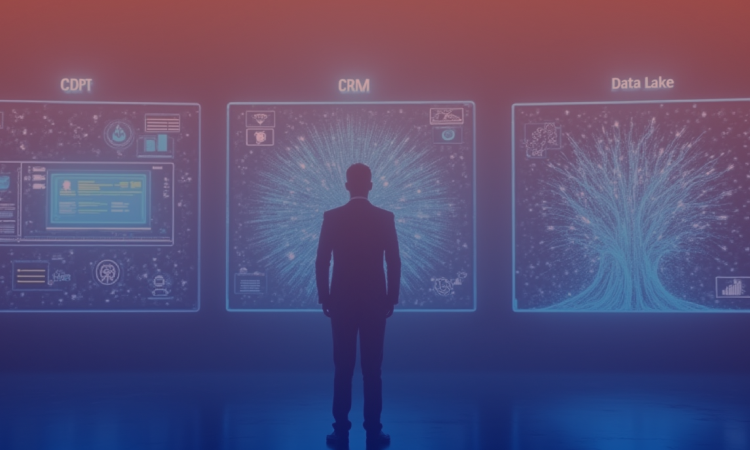
Customer data has become one of the most valuable assets enterprises manage. In 2026, most organizations already operate multiple systems that claim to deliver a “single view of the customer.” CRMs promise relationship clarity. CDPs promise real-time personalization. Data lakes promise limitless analytical depth.
The challenge is not deciding which tools to buy. Teams must decide what role each tool should play, and just as importantly, what it should not be used for. When they fail to do this, teams duplicate capabilities, fragment customer intelligence, and inflate costs without improving outcomes.
This article clarifies where CRM, CDP, and data lakes genuinely fit, where overlap usually occurs, and how to design a data stack that scales without redundancy.
CRM: Your Customer Relationship Engine
A Customer Relationship Management platform exists to support customer-facing work. It organizes interactions across sales, service, and marketing so teams can manage opportunities, cases, and engagement histories consistently.
CRMs support structured workflows by tracking deals, managing support tickets, logging communications, and coordinating outreach. Teams rely on them for operational execution. However, CRMs typically do not ingest high-volume behavioral data or power real-time personalization across channels.
When organizations try to turn the CRM into a behavioral data hub, performance often suffers and flexibility declines. CRM works best when it remains focused on relationship execution rather than data aggregation.
CDP: Real-Time Personalization and Activation
A Customer Data Platform serves a different purpose. A CDP unifies behavioral data from websites, mobile apps, email, advertising, and offline systems into continuously updated customer profiles that teams can activate in real time.
CDPs excel at segmentation, journey orchestration, and contextual decisioning. They allow marketing and CX teams to respond to what customers are doing now, not just what they did last quarter. However, they generally do not replace operational systems used for sales, service, or workflow management.
Their value lies in speed and relevance, not operational control.
Data Lake: The Raw Data Foundation
A data lake is the foundation for enterprise-scale analytics. It stores vast volumes of structured and unstructured data, including transactions, events, logs, third-party feeds, and more, without enforcing a predefined schema.
This makes data lakes indispensable for business intelligence, machine learning, and advanced modeling. However, they are not typically designed for direct customer engagement. Turning raw lake data into usable customer profiles requires significant engineering, governance, and transformation layers.
A data lake supports insight. It does not replace the systems that act on customers in real time.
How the Roles Differ in Practice
| Dimension | CRM | CDP | Data Lake |
| Primary Users | Sales, service, ops | Marketing, CX | Data & analytics teams |
| Primary Function | Manage relationships | Activate customer data | Store and analyze data |
| Data Type | Interaction records | Unified behavioral profiles | Raw enterprise data |
| Speed | Operational responsiveness | Activation latency | Analytical processing |
| Outcome | Execution | Personalization | Insight |
This distinction is necessary because each platform is optimized for a different outcome. Problems arise when one tool is forced to play all three roles.
Platform Examples That Illustrate Role Clarity
Salesforce is a strong example of a CRM that excels at managing sales automation, service workflows, and account visibility. Its value increases when it is paired with a CDP rather than overloaded with behavioral data it isn’t designed to manage.
Adobe Experience Platform demonstrates how a CDP can unify real-time customer signals while integrating with consent management and analytics. It enables personalization at scale without requiring every interaction to pass through a data lake first.
Amperity focuses heavily on identity resolution and clean customer profiles. It is often used to improve marketing activation alongside existing CRMs, offering a lighter operational footprint than building customer views directly in analytical infrastructure.
For analytics foundations, platforms such as Snowflake and Databricks provide scalable data lake and lakehouse capabilities. These environments are powerful when they support downstream systems, but costly and slow when treated as engagement platforms.
Where Overlap Creates Real Cost
The most common mistake is trying to stretch one platform too far:
- Using the CRM as a substitute for a CDP, which limits personalization and creates data silos
- Using the data lake as a CDP delays activation and increases engineering dependency
A more durable model assigns clear responsibility:
- CRM for operational relationships
- CDP for real-time activation
- Data lake for analytics and AI
When these systems share identifiers and integrate through APIs, organizations reduce duplication and improve agility. Without this discipline, overlapping tools increase license, integration, and engineering costs without improving outcomes.
A Practical Decision Framework for 2026 Buyers
Instead of starting with vendors, start with outcomes.
If the priority is real-time personalization and journey orchestration, a CDP should come first. If the focus is on sales execution or service efficiency, CRM investment is foundational. If advanced analytics, forecasting, or machine learning is the goal, a data lake is non-negotiable.
Maturity matters as well:
- Early-stage teams typically need CRM plus lightweight activation
- Growth-stage teams benefit from a full CDP alongside CRM
- Enterprises require all three, tightly integrated and clearly scoped
Buying ahead of maturity almost always leads to shelfware.
Conclusion: Integration Wins, Duplication Loses
In 2026, effective data stacks are the ones that are clear and intentional. CRM, CDP, and data lakes each play a distinct role. Problems emerge only when those boundaries blur.
The winning approach is integration over redundancy. Define one system per role, integrate them cleanly, and measure success by business outcomes, not tool count. A well-designed stack accelerates revenue and experience. A poorly defined one only generates more data and less clarity.
The most important factor to determine is whether each platform in your stack knows exactly what job it is there to do.